USDA NOP • EU Organic • JAS • FSSAI • APEDA • HACCP Certified
Organic • Ginger Root
Organic Ginger Root: The Complete Guide from Our Farms
What makes ginger truly organic? Where does the world’s finest ginger grow, why does the dry root bite harder than the fresh one, and how do you judge a good rhizome at a glance? A third-generation grower’s guide to Zingiber officinale — the spice that built trade routes.
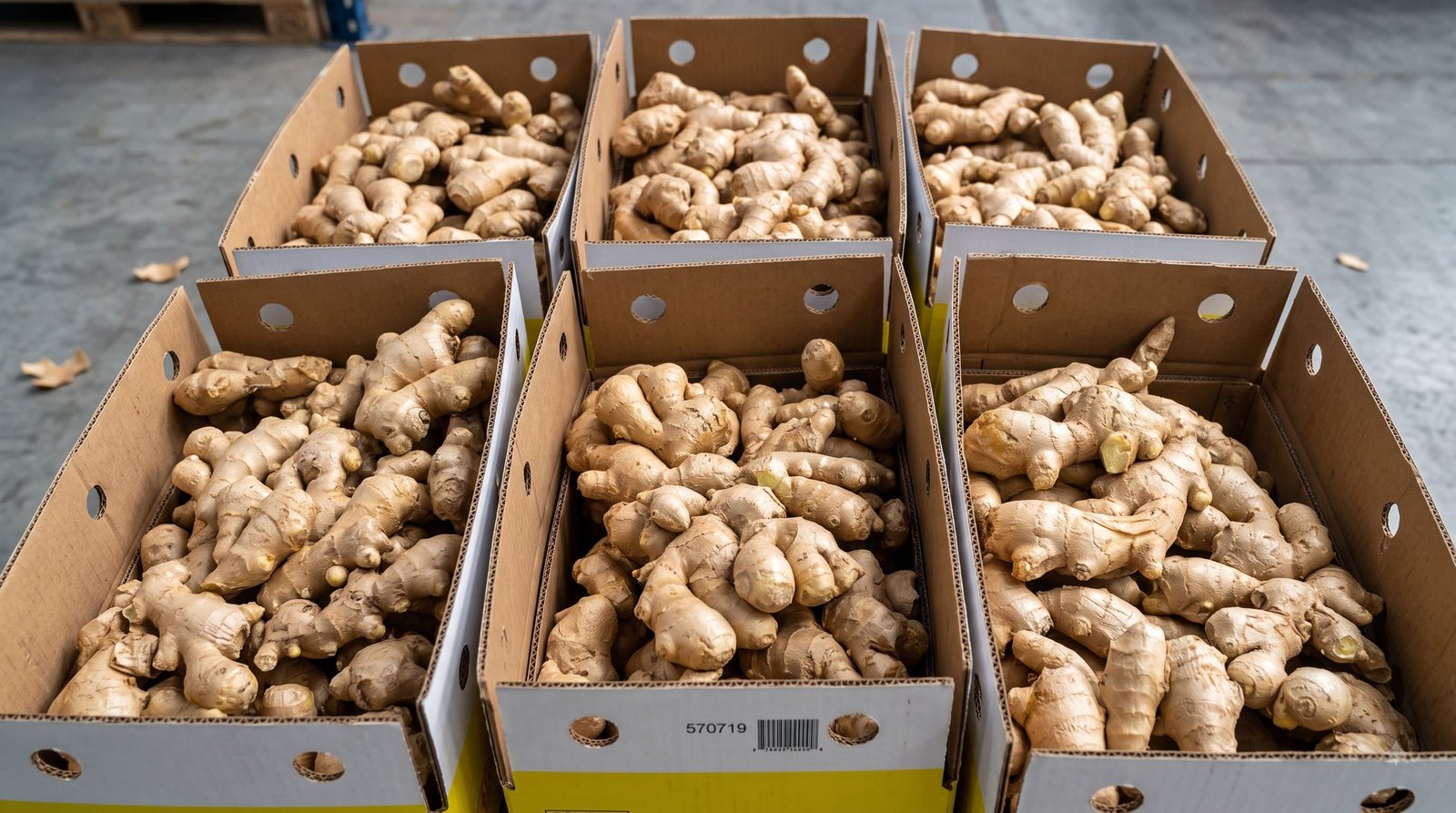
This season’s certified harvest — graded & crate-packed for export
Ginger is the spice that taught the world geography. Before it sat in every kitchen drawer, it built sea routes, filled Roman apothecaries and paid medieval rents — and every metre of that journey began with a knobbly, pale-yellow stem growing sideways under warm soil. This guide is our full, farm-level answer to the questions buyers ask most often: what exactly is ginger root, what “organic” certifies, where ours grows, why the fresh and dry versions taste so different, and how to recognise a good rhizome when you see one.
The Plant
What Exactly Is Ginger Root?
The first thing to know: ginger isn’t a root at all. The piece you buy is a rhizome — a swollen underground stem that grows horizontally just beneath the soil surface, storing the plant’s energy, pushing roots downward and leafy shoots upward. Botanically it is Zingiber officinale Roscoe, and it keeps good spicy company: turmeric, cardamom and galangal are all cousins in the Zingiberaceae family.
Sanskrit speakers called it srngaveram — “horn-body” — five thousand years ago, and the trade still uses their vocabulary: a whole rhizome is a “hand”, its branches are “fingers”. Above ground the plant stands 90–120 cm of slender, glossy canes that pass for reeds. It rarely flowers in cultivation — by the time it might, we have already harvested what we grow it for.
One botanical detail matters enormously in commerce: seed-grown ginger is essentially unknown. Every plant is a clone — a piece of last season’s rhizome replanted — which is why clean, certified planting material is the single most consequential decision in the entire crop.
Certification
What “Organic” Actually Means
“Organic” is not a promise a grower makes; it is a system an auditor checks. Our ginger carries three of the world’s major organic flags — USDA NOP for the United States, EU & GB Organic for Europe and the United Kingdom, and JAS for Japan. The regimes differ in detail, but the core is identical: no synthetic pesticides, herbicides or fertilisers, no irradiation, no GMOs and no treated sewage sludge — ever.
In practice that means building fertility with compost and manures, breaking pest cycles with crop rotation and buffer zones away from conventional fields, and documenting every input on every plot. Certification is re-earned annually: field inspections, residue testing of the harvested crop, and a paper trail that traces each lot back to the exact field it grew in.
Our own operation spans 5,200 certified acres plus 850+ partner growers managed under one Internal Control System, so every grower follows the same rulebook and every container can be traced to its plot. When a buyer asks “how do I know this is organic?”, the honest answer is a scope certificate, transaction certificates and a laboratory report — not our word for it.
Sourcing
Terroir: Why Six Indian States Grow Such Good Ginger
Ginger is a tropical crop with particular tastes: warm days, generous and well-spread rainfall (1,500–3,000 mm), loose rich loam, and dappled shade in the hotter belts. East and Northeast India delivers all four — which is why our grower network spans six states, each contributing a slightly different character to the harvest.
State
Growing belt
Character it gives the rhizome
Assam
Brahmaputra valley & foothills
Bold, heavy hands; high juice content
Tripura
Jampui & Atharamura foothills
Plump fingers, clean thin skin
Meghalaya
Mid-hill terraces, 300–1,200 m
Slow maturity, concentrated aroma
Sikkim
Himalayan mid-hills
Fully organic state since 2016; intense pungency
Odisha
Laterite plateau
Early-season crop, balanced heat
West Bengal
Terai & northern plains
Smooth fibre, cures well for dry
Altitude is the quiet variable. In the Assam valley and Tripura foothills, long warm seasons produce bold, heavy, high-juice hands that suit fresh export. In the Meghalaya and Sikkim mid-hills — up to about 1,200 m — cooler nights slow the crop down, and slow growth concentrates volatile oil and pungency: precisely what dry-ginger and oleoresin buyers want. For sourcing, this is a toolbox: a single-origin lot keeps a state’s signature, while blending across belts lets us hit tight specifications consistently across a whole season.
Shade-tended organic ginger on mulched beds in the mid-hills — mulch is moisture, fertility and weed control in one.
Cultivation
Nine Months from Seed Rhizome to Harvest
The season starts before the rains. Seed rhizomes are selected at the previous harvest from the healthiest certified plots, stored in dry sand, and treated before planting with compost extracts and traditional cow-based formulations — the organic equivalent of the chemical seed treatments conventional growers depend on.
Planting rides the pre-monsoon showers in April and May: raised beds, well-rotted farmyard manure worked into the soil, seed pieces set 20–25 cm apart and covered. Then comes the practice that defines organic ginger — thick mulching. A heavy blanket of straw or leaf litter holds moisture, feeds the soil as it breaks down, and smothers weeds. Hand weeding is, honestly, the biggest labour line in an organic ginger budget — and the reason organic ginger costs what it costs.
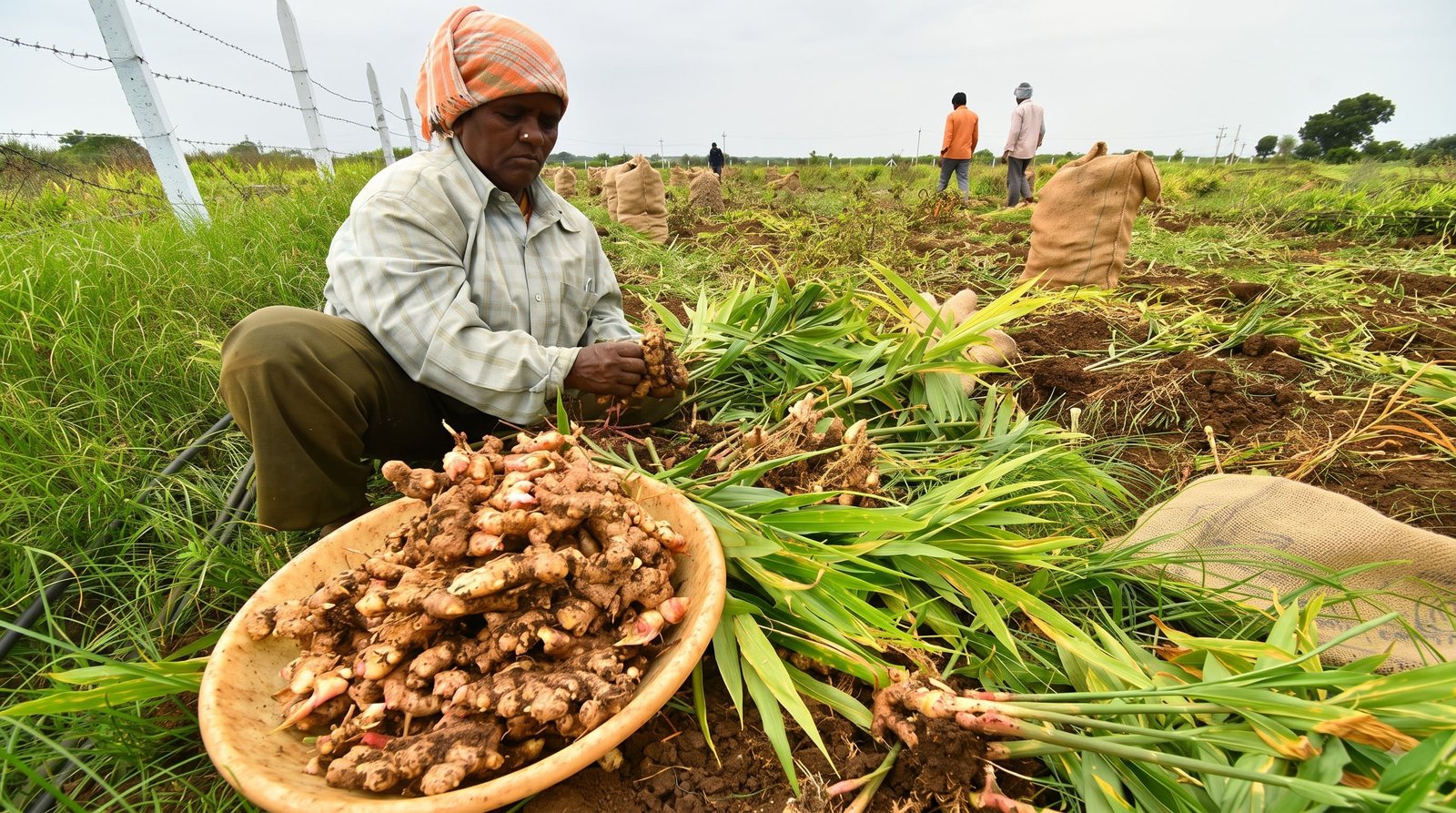
The monsoon raises the canopy through June to September; the rhizomes swell steadily from September to November, with a final earthing-up to keep them covered. Fresh lifting begins at eight to ten months — December into February — done by hand with a fork, only when lab chemistry says oleoresin and gingerol have peaked. Rhizomes reach the pack-house within six hours of leaving the field. What stays in the ground longer matures fully, and becomes next year’s seed stock — and the dry-ginger crop.
Hand-lifting at nine months — rhizomes are forked out of loose soil, never pulled by the canes.
Science
The Chemistry of the Bite: Gingerols, Shogaols, Zingerone
Why does ginger burn — and why do the fresh and dry versions burn differently? The answer is a family of phenols. In the fresh rhizome the dominant one is 6-gingerol: sharp, clean, lemony-peppery. When ginger is dried or heated, gingerol loses water and converts to shogaol — roughly twice as pungent, deeper and sharper. Cook it long and slow, and shogaol softens into zingerone, the warm, sweet-spicy note in gingerbread and masala chai.
A gingerol assay is the most honest tasting note there is. 1.4% is the difference between ginger that whispers and ginger that answers back.
Same root, three molecules, three personalities. This is why a fresh grating and a dried powder are not interchangeable in a recipe — and why serious buyers of dry ginger talk in chemistry, not adjectives. Our dry spec quantifies it: 6-gingerol at 1.0% minimum by HPLC (our latest released batch tested 1.42%), total pungent compounds at 1.5% minimum (tested 2.00%), and volatile oil at 1.5 mL per 100 g minimum, typically 2.0–2.5. Every figure is measured per batch and printed on the Certificate of Analysis — chemistry as a flavour guarantee.
Products
Fresh vs. Dry: Two Products, One Root
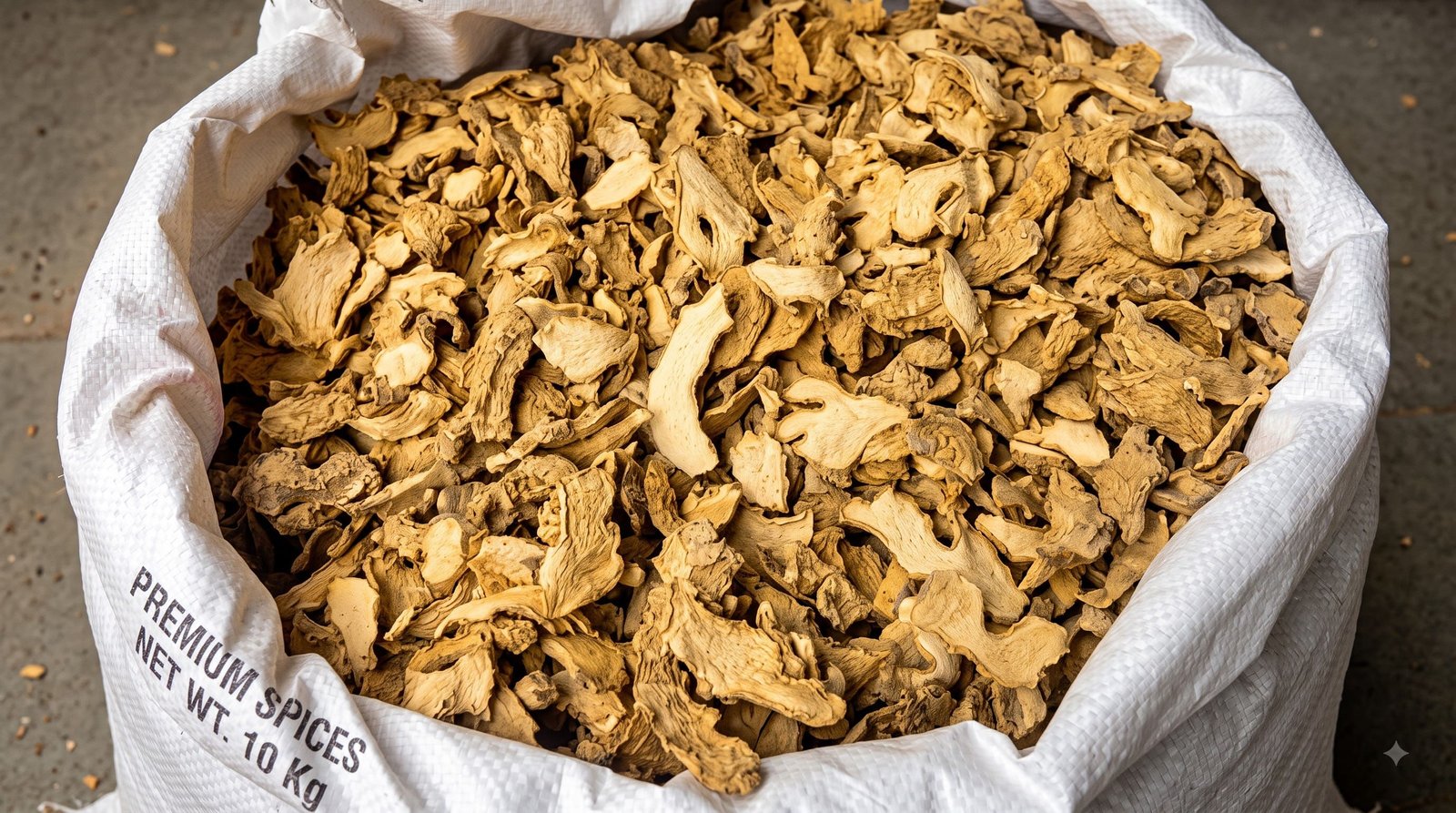
Everything above ground is one crop; everything we ship is two products. Fresh (raw) ginger is lifted at eight to ten months and shipped cool. Dry ginger is fully mature, sun-cured and dried to roughly a third of its fresh weight. Here is the comparison that matters to a buyer:
Neither is “better”. Fresh sells the story of the farm; dry sells the story of the chemistry. Most of our buyers take both — fresh for the produce aisle, dry for the mill.
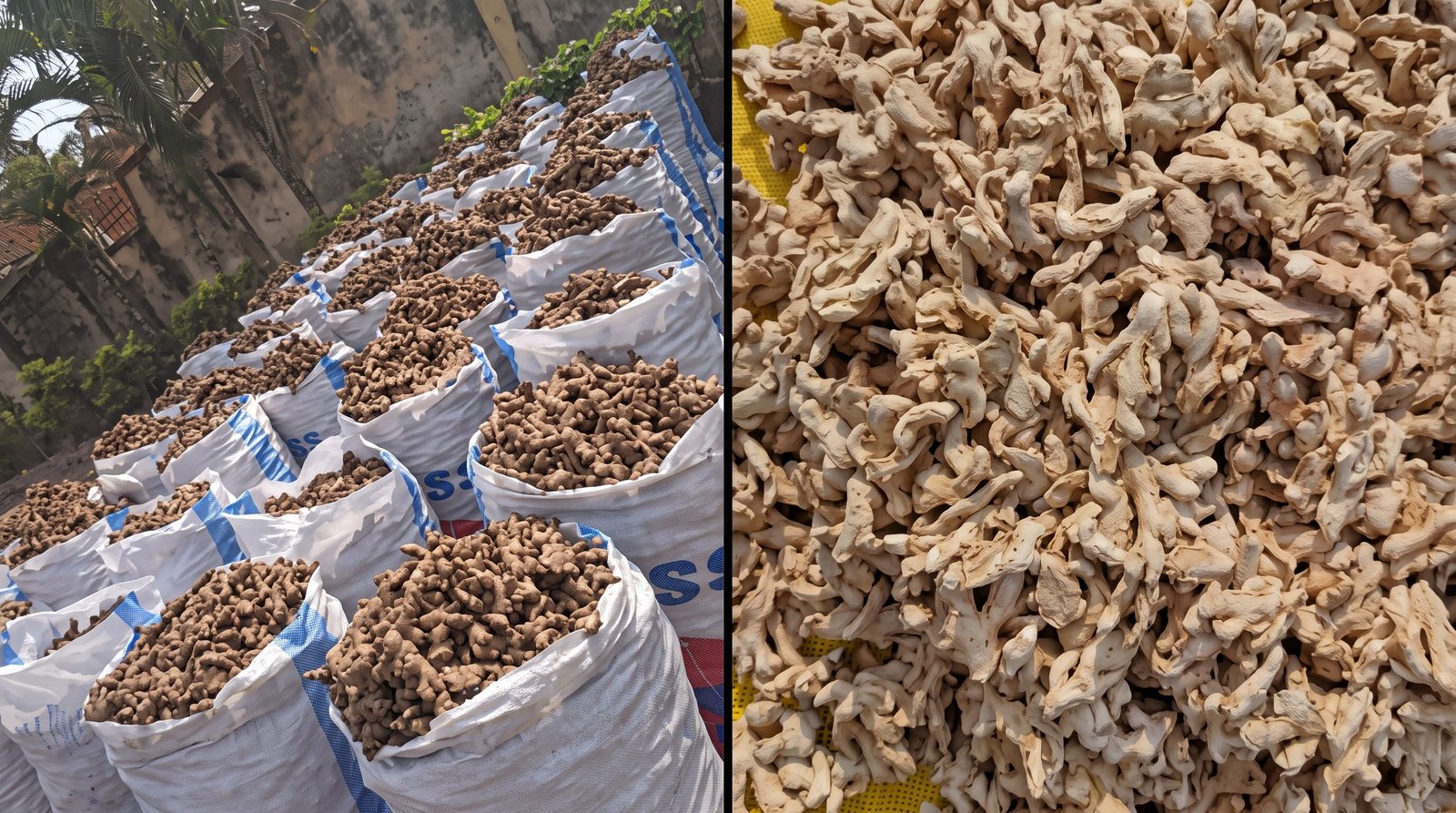
Sun-dried organic ginger — unbleached whole fingers ready for grading and packing.
Assurance
Quality You Can Verify: The Batch COA
Trust, but test. Before any lot is released for export, samples go to an accredited laboratory and the results return on a Certificate of Analysis that travels with the shipment: heavy metals — lead, cadmium, arsenic, mercury — against strict maximum limits; a multi-residue pesticide screen covering hundreds of compounds; and microbiology — Salmonella, E. coli, yeasts and moulds. Dry lots add the full HPLC pungency profile.
The rule is binary: a batch is either within specification — released — or it is not, and it never ships. If you are evaluating ginger suppliers, ask for a recent COA before you ask for a price. Ours are downloadable batch by batch on the COA Reports page.
Trade
Export Documentation: The Paper Trail Behind Every Container
A container of ginger does not cross a border on goodwill alone — it travels with a dossier. Between our farm gate and your warehouse, the shipment accumulates a standard set of export documents, and each one exists to answer a question somebody downstream will certainly ask: what is inside, where was it grown, is it safe, is it genuinely organic, and who stands behind it. We prepare the full set in-house, in parallel with loading, so the paperwork never adds a day to a sailing.
Document
What it certifies
Commercial invoice & packing list
The transaction itself — values, Incoterm, HS code, and the carton-by-carton net and gross weight map of the container
Bill of lading / airway bill
The contract of carriage and document of title — issued at loading for sea (B/L) or air (AWB) freight
Phytosanitary certificate
Plant-quarantine inspection at loading: the consignment is free of regulated pests and fit to import
Certificate of origin
Where the ginger was grown and packed; supports preferential duty where a trade agreement applies
Certificate of analysis
The batch COA — heavy metals, pesticide residues, microbiology, plus the HPLC pungency profile on dry lots
ISPM-15 & treatment records
Heat-treated, stamped pallets and any quarantine treatment the destination requires, documented
Insurance certificate
Cargo cover for the journey, as per the agreed Incoterm
Organic shipments carry a second layer. The certifier issues a transaction certificate (TC) for every lot that leaves our warehouses — the auditable link between a container and the certified fields it came from. Importing into the EU or Great Britain adds a certificate of inspection (COI) filed through the TRACES system before the vessel sails, while NOP consignments to the United States are matched against the importer’s USDA paperwork. None of it is optional: an organic lot that arrives without its COI can be held at the port and sold as conventional — so we treat the organic file with the same seriousness as the phyto.
In practice, you receive a draft document set for approval before loading, scans of the complete set within three working days of the vessel sailing, and the originals by courier — or as telex release where your bank accepts it. Everything lands in one labelled mail, in the same order as the packing list, because the fastest document to clear customs is the one that is easiest to find.
At Home
Choosing and Storing Organic Ginger Root
Whether you are buying a kilo at the market or a container at the port, the same physics applies. A good rhizome is alive and full of water — everything below follows from that.
How to choose a good hand
Firm and heavy for its size — weight is water, and water is flavour
Taut, thin skin; wrinkles mean the rhizome is already drying out
No soft spots, dark patches or mould at the finger tips
The snap test: a fresh finger breaks cleanly and juicy; visible fibres mean an over-mature crop
A bright lemon-pepper aroma at the break — dull or musty, walk away
How to store it
Whole and unpeeled, in the fridge crisper in a breathable bag: three to four weeks
Never seal cut or peeled pieces in plastic — trapped moisture breeds mould
Freeze it whole and grate straight from frozen — keeps about six months and grates more finely
A piece with a bud-eye planted in a pot makes a glossy, reed-like houseplant — it is a stem, after all
One organic bonus: ginger grown without synthetic inputs typically carries thinner skin than conventional ginger, so there is rarely any reason to peel it at all — a quick scrub keeps the aromatic oils that sit just beneath the surface.
Bring This Season’s Organic Ginger to Your Shelf
Fresh hands and dry fingers — USDA NOP, EU & GB Organic and JAS certified, batch-tested with COA, packed to survive thirty days at sea and shipped in temperature-logged reefers to 40+ countries. Tell us your specification; we will tell you what is in the warehouse this week.